
The time it takes to move a pointer along a bounded path increases with the path’s length and decreases with its width.
Overview
Many interactions require people to guide a pointer or finger along a path without straying outside it: moving through a cascading menu, dragging a slider, or scrubbing through a video timeline. The Steering Law describes how long these path-steering tasks take.[1][2]

The insight is intuitive once stated: long, narrow paths are slow and error-prone; short, wide paths are fast and forgiving. Think of driving down a winding road: the narrower it is, the slower you must go to stay on it.[2]
The law is expressed as T = a + b × (A / W), where T is the time taken, A is the length of the path, W is its width, and a and b are constants measured for a particular device. Most teams will never need the equation; the practical lesson is to make paths shorter and wider.[2][3]
Why it matters
Hover-based navigation menus, sliders, and drag interactions are common in enterprise and web applications. When the path is narrow, a small slip, such as moving diagonally toward a submenu, can close a menu or drop an item, forcing people to start over.
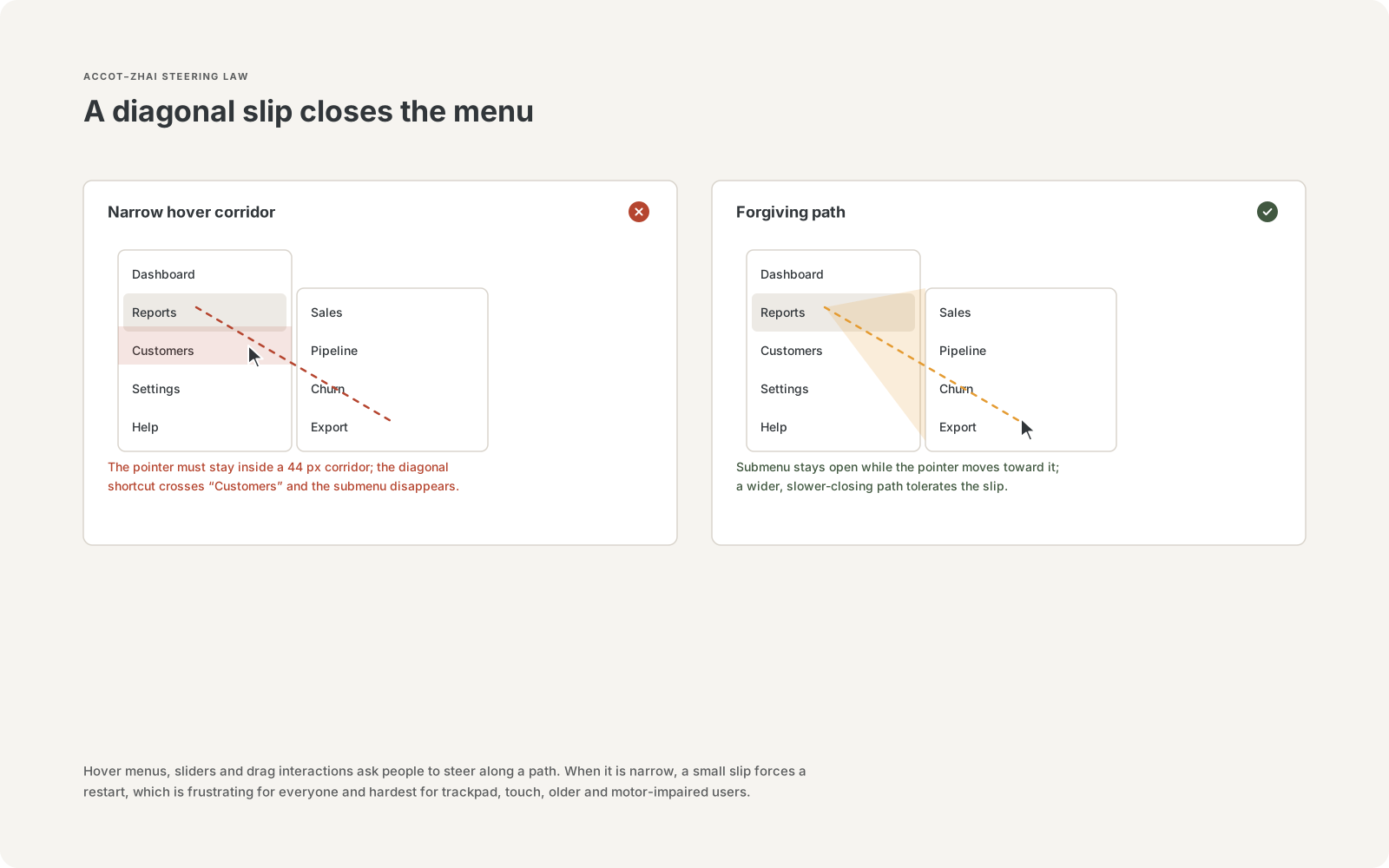
These errors are frustrating for everyone and particularly difficult for people with motor impairments, older users, and anyone using a trackpad or touchscreen.[6]
Key takeaways
- Make paths short and wide. Generous menu item heights and wide hit areas reduce slips.
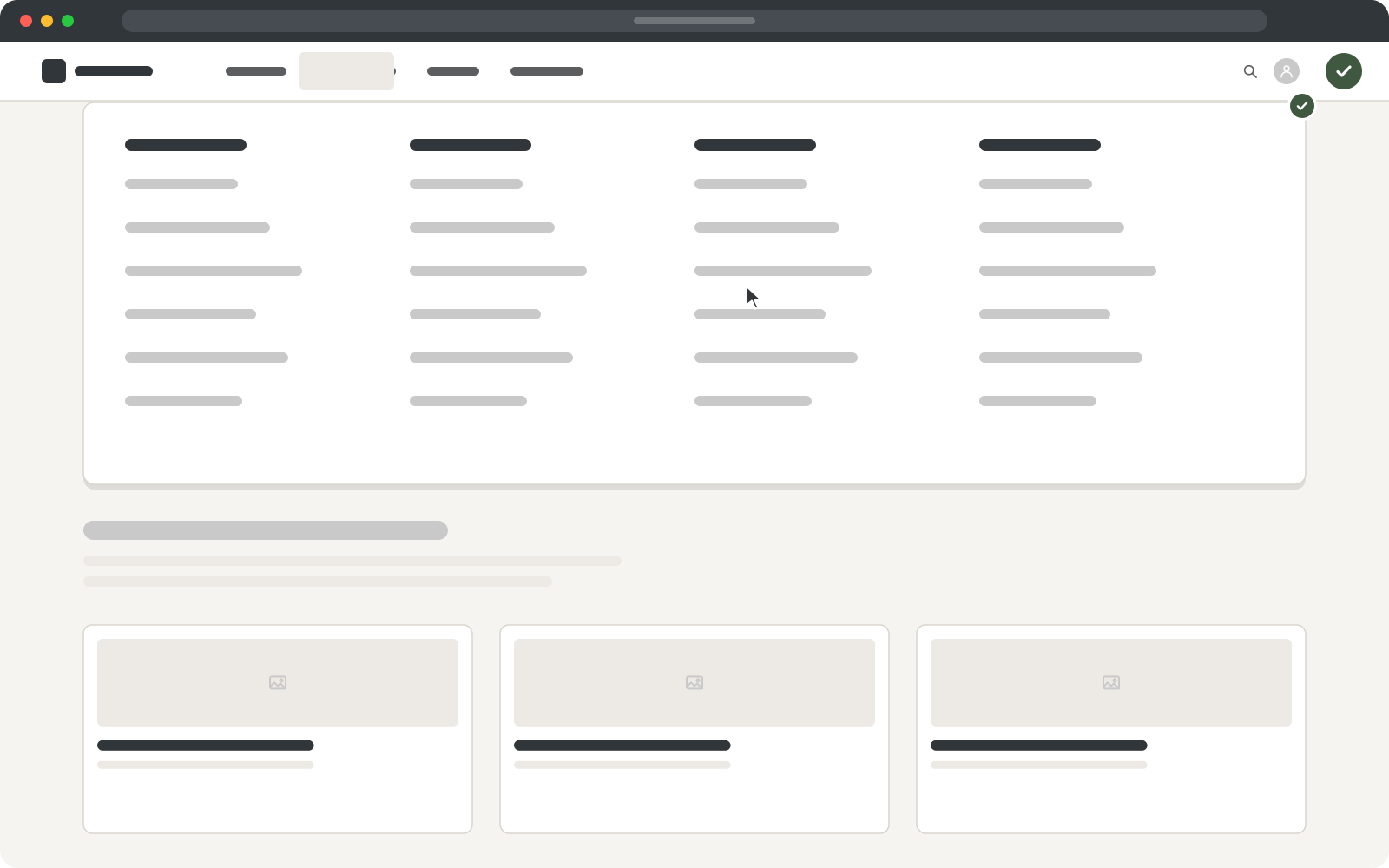
- Avoid deep cascading menus. Each level adds another narrow path to steer through; consider mega menus instead.[4]
- Be forgiving of small slips. Brief delays before hiding submenus let people move diagonally without losing them.[5]
- Offer alternatives to dragging. Sliders and drag-and-drop interactions should have an alternative, such as a text field or buttons.[6]
- Provide precision controls. Long sliders and timelines benefit from step buttons or direct input.[2]
In practice

Common patterns in business applications, portals, and internal tools:
Supports the principle | Undermines the principle |
|---|---|
Mega menus that show options in a wide panel. | Three levels of narrow, hover-revealed submenus. |
Submenus that remain open briefly when the pointer slips. | Submenus that vanish the instant the pointer leaves. |
Sliders paired with a number field. | Sliders as the only way to enter a precise value. |
Drag-and-drop with a keyboard or button alternative. | Reordering that is possible only by dragging. |
Generous row heights in menus and lists. | Dense menus with tightly packed, narrow items. |
Questions to ask in a design review
- Does this interaction require steering through a narrow path?
- What happens if someone slips outside the path?
- Is there an alternative for people who cannot drag precisely?
- Could the menu be flatter or wider?
Origin
The law was formalized for human–computer interaction by IBM researchers Johnny Accot and Shumin Zhai in their 1997 paper Beyond Fitts’ Law: Models for Trajectory-Based HCI Tasks. They derived it mathematically from Fitts’ Law, which governs pointing at a target, and verified it experimentally.[3][1]
The relationship has been independently discovered three times: by Nicolas Rashevsky in 1959 in work on automobile driving, by Colin Drury in 1971 in a study of movements with lateral constraint, and by Accot and Zhai in 1997, whose formulation is the most general.[1][7]
Related concepts
- Fitts’ Law — the pointing law the Steering Law extends
- Hick’s Law — more choices in a menu take longer to decide
- Doherty Threshold — delays in menus must stay short
- Constraints — path boundaries constrain movement
- Feedback — show people when they are inside a path
- Principle of Least Effort — people choose easier paths
References and further reading
- Wikipedia. Steering Law. https://en.wikipedia.org/wiki/Steering_law
- Nielsen Norman Group. Accot-Zhai Steering Law: Implications for UI Design. https://www.nngroup.com/articles/steering-law/
- Accot, J., & Zhai, S. (1997). Beyond Fitts’ Law: Models for Trajectory-Based HCI Tasks. Proceedings of CHI ’97. https://doi.org/10.1145/258549.258760
- Nielsen Norman Group. Mega Menus Work Well for Site Navigation. https://www.nngroup.com/articles/mega-menus-work-well/
- Nielsen Norman Group. Timing Guidelines for Exposing Hidden Content. https://www.nngroup.com/articles/timing-exposing-content/
- W3C. Understanding Success Criterion 2.5.7: Dragging Movements. WCAG 2.2. https://www.w3.org/WAI/WCAG22/Understanding/dragging-movements.html
- Drury, C. G. (1971). Movements with Lateral Constraint. Ergonomics, 14(2). https://doi.org/10.1080/00140137108931246
- W3C. Understanding Success Criterion 2.5.8: Target Size (Minimum). WCAG 2.2. https://www.w3.org/WAI/WCAG22/Understanding/target-size-minimum.html
- Yablonski, J. Laws of UX (format inspiration for this series). https://lawsofux.com/