
People naturally choose the path that requires the least effort, and stop as soon as they find a result that is good enough.
Overview
Given a choice, people take the easiest available route. When looking for information, they use the most convenient source rather than the best one, and they stop searching as soon as they find something acceptable. This holds regardless of how skilled or knowledgeable the person is.[1]

A familiar example: many people will ask a nearby colleague rather than look up an authoritative source in another system, as long as the colleague’s answer seems good enough.[1] In digital products, people click the first plausible link, accept defaults, and use workarounds rather than learn the “right” way.[5][6]
This is not laziness. Mental and physical effort are real costs, and research shows people consistently avoid more demanding options when a less demanding one will do.[4]
Why it matters
If the correct or intended path is harder than an alternative, people will take the alternative, whether that is a workaround, a shadow spreadsheet, or a competitor’s product. Designs succeed when the right path is also the easiest one.
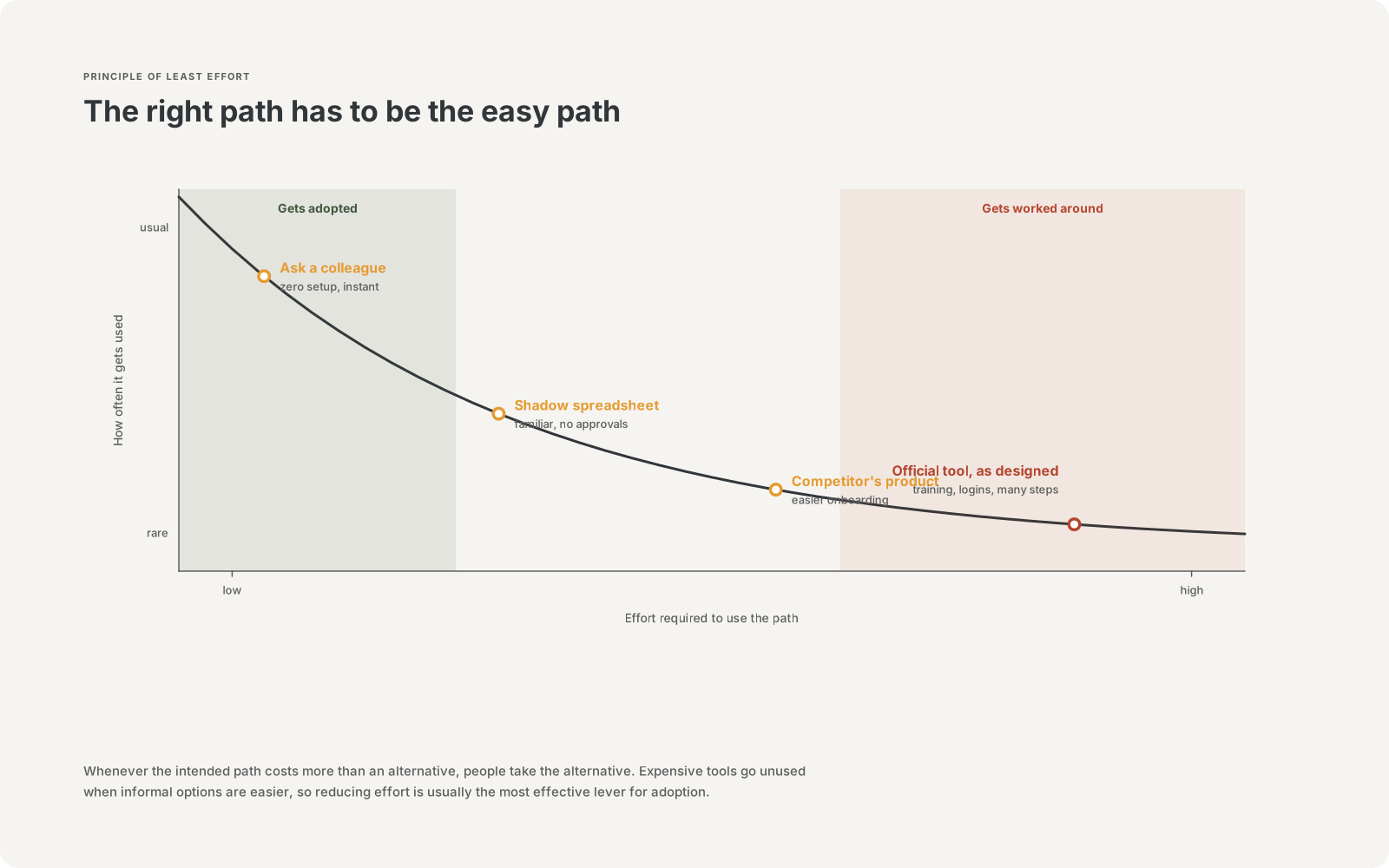
For organizations, the principle explains why expensive tools go unused when easier informal options exist, and why reducing effort is often the most effective way to drive adoption of a new system or process.
Key takeaways
- Make the right path the easiest path. Intended behaviors should require the least effort.
- Reduce steps, fields, and decisions in common tasks.
- Design for “good enough” answers. People accept the first acceptable result, so put the best results first.[6]
- Provide strong information scent. Clear labels help people choose the right link on the first try.[5]
- Use effective defaults. Most people accept what is pre-selected.[7]
In practice

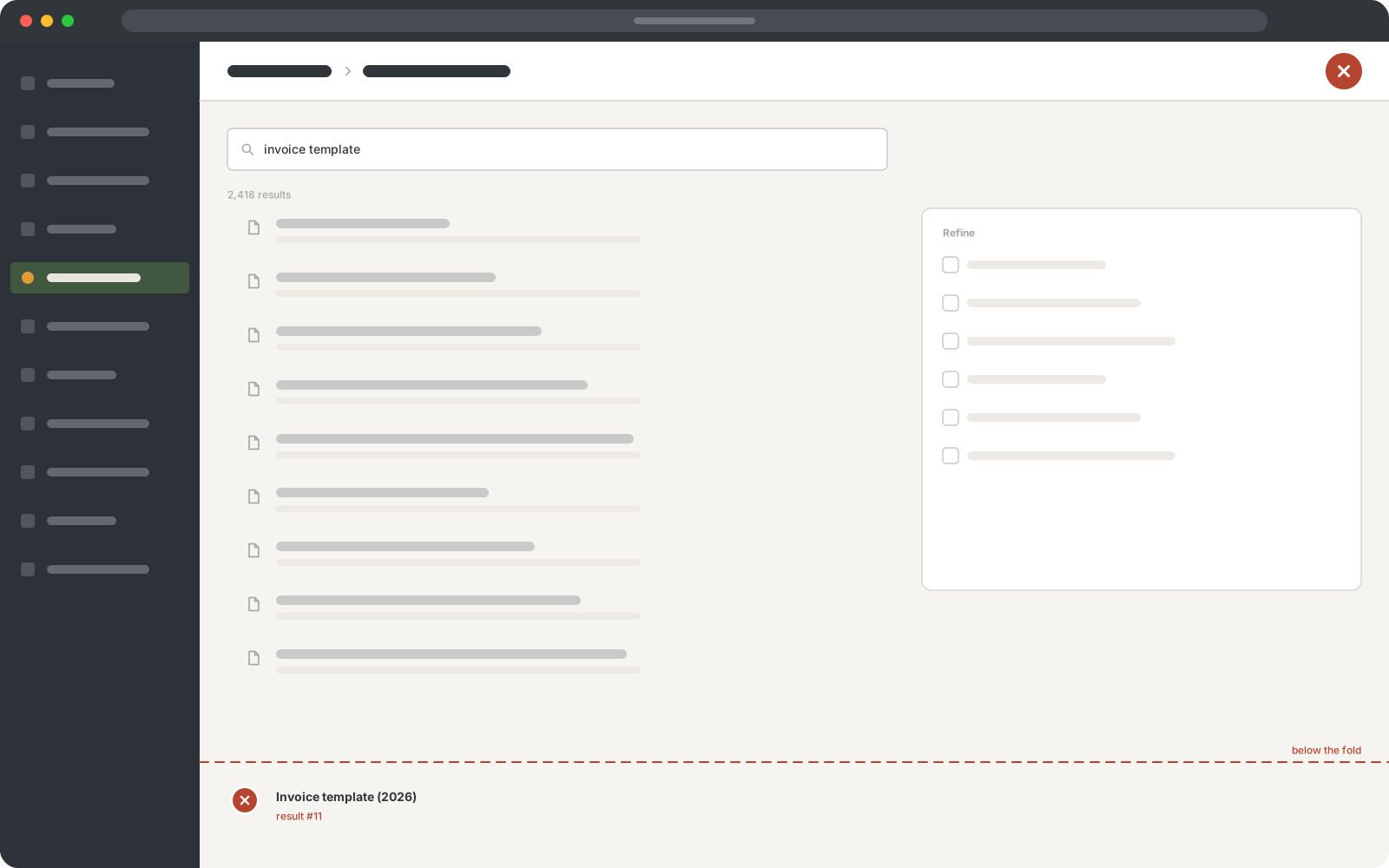
Common patterns in business applications, portals, and internal tools:
Supports the principle | Undermines the principle |
|---|---|
The most common task available in one or two steps. | Common tasks buried in deep menus. |
Best search results shown first. | Relevant results that require scrolling or refining. |
Pre-filled information the system already knows. | Asking people to re-enter known information. |
Clear, descriptive link labels. | Vague labels that require trial and error. |
An official process that is easier than the workaround. | An official process so cumbersome that people avoid it. |
Questions to ask in a design review
- Is the intended path the easiest one available?
- What workarounds do people use today, and why?
- Where can we remove steps, fields, or decisions?
- Will the first result people see be good enough?
Origin
The principle was first articulated by the Italian philosopher Guillaume Ferrero in an 1894 article in the Revue philosophique de la France et de l’étranger.[1]
About fifty years later, Harvard linguist George Kingsley Zipf studied it in depth in his 1949 book Human Behavior and the Principle of Least Effort. He argued that people’s tendency to communicate efficiently with the least effort explains why a few words are used very often while most are used rarely, a pattern now known as Zipf’s law.[2][3][8] Library and information science later adopted the principle as a core model of information-seeking behavior.[1]
Related concepts
- Paradox of the Active User — people act rather than learn
- Pareto Principle — a few sources satisfy most needs
- Hick’s Law — more choices require more effort
- Cognitive Load — mental effort is a real cost
- Occam’s Razor — favor the simplest solution
- Tesler’s Law — someone must absorb the effort
References and further reading
- Wikipedia. Principle of Least Effort. https://en.wikipedia.org/wiki/Principle_of_least_effort
- Zipf, G. K. (1949). Human Behavior and the Principle of Least Effort: An Introduction to Human Ecology. Addison-Wesley. https://archive.org/details/humanbehaviorpri0000geor
- Wikipedia. Zipf’s Law. https://en.wikipedia.org/wiki/Zipf%27s_law
- Kool, W., McGuire, J. T., Rosen, Z. B., & Botvinick, M. M. (2010). Decision Making and the Avoidance of Cognitive Demand. Journal of Experimental Psychology: General, 139(4). https://doi.org/10.1037/a0020198
- Nielsen Norman Group. Information Scent: How Users Decide Where to Go Next. https://www.nngroup.com/articles/information-scent/
- Nielsen Norman Group. Satisficing in UX Design: Fast Access to Good-Enough Stuff. https://www.nngroup.com/articles/satisficing/
- Nielsen Norman Group. The Power of Defaults. https://www.nngroup.com/articles/the-power-of-defaults/
- Wikipedia. George Kingsley Zipf. https://en.wikipedia.org/wiki/George_Kingsley_Zipf
- Pirolli, P., & Card, S. (1999). Information Foraging. Psychological Review, 106(4). https://doi.org/10.1037/0033-295X.106.4.643
- Wikipedia. Satisficing. https://en.wikipedia.org/wiki/Satisficing
- Yablonski, J. Laws of UX (format inspiration for this series). https://lawsofux.com/